


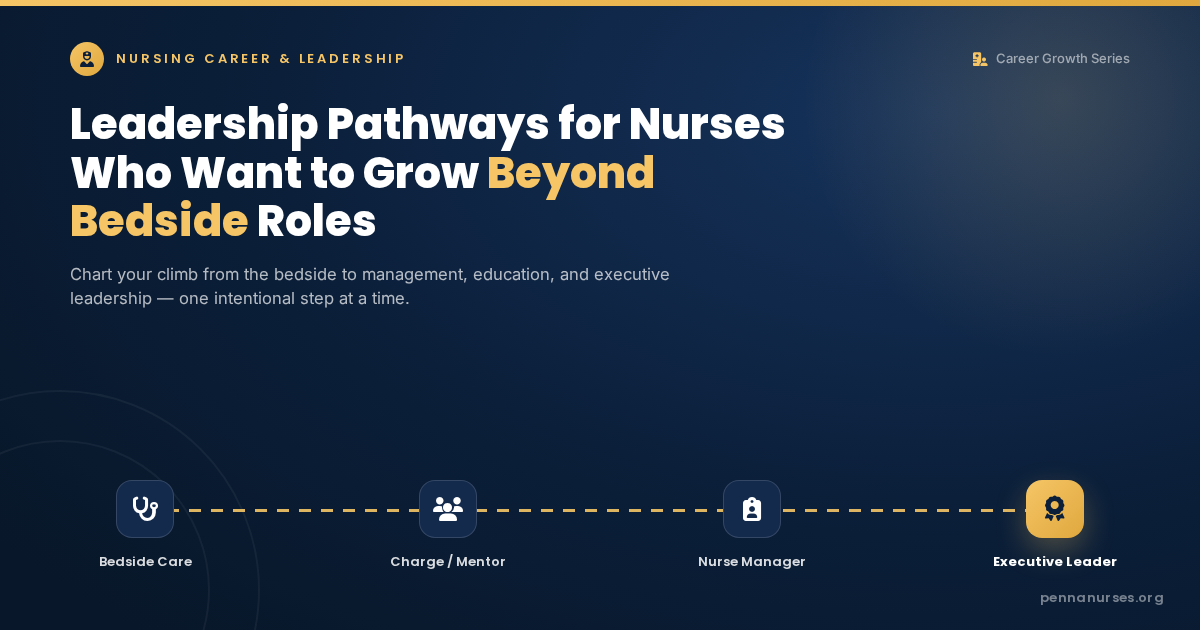
There comes a point in many nursing careers when the work at the bedside — no matter how meaningful — starts to feel like a ceiling rather than a calling. The clinical skills are sharp, the patient interactions still matter, but a quiet question begins to surface: what comes next?
The good news is that nursing has evolved far beyond a single-track profession. Today’s nursing leadership pathways stretch across administration, education, policy, entrepreneurship, and advanced practice — each one built on the clinical foundation that bedside nurses already possess. The challenge is not a lack of options. It is knowing which path fits and how to start walking it.
Why Leadership Matters More Than Ever in Nursing
Healthcare is facing a convergence of pressures — staffing shortages, rising patient acuity, regulatory complexity, and the growing demand for value-based care. These challenges cannot be solved by clinicians alone. They require nurses who can think systemically, influence organizational strategy, and advocate for both patients and the professionals who serve them.
Career growth for nurses is no longer a personal ambition — it is an industry necessity. When experienced nurses step into leadership, they bring a perspective that no MBA or policy analyst can replicate: they understand what happens at 3 a.m. on an understaffed unit, and they carry that knowledge into the boardroom.
Clinical Leadership: Leading Without Leaving the Floor
Not every leadership path requires leaving patient care behind. Clinical leadership roles allow nurses to shape practice standards, mentor newer staff, and drive quality improvement while maintaining a direct connection to patient outcomes.
Charge Nurse and Unit Coordinator roles are often the first taste of leadership. They involve shift-level decision-making — staffing adjustments, patient flow management, and real-time problem solving — and they build the operational instincts that more senior roles demand.
Clinical Nurse Leaders (CNLs) take a broader view, overseeing care coordination across a unit or service line. They analyze outcomes data, implement evidence-based protocols, and serve as a bridge between frontline staff and organizational leadership.
Nurse Educators within clinical settings design orientation programs, lead competency assessments, and ensure that new hires and seasoned staff alike stay current with evolving best practices. For nurses who find fulfillment in teaching at the bedside, this pathway formalizes that instinct into a defined role.
Administrative and Executive Leadership
For nurses drawn to the business side of healthcare, administrative leadership offers a path to system-wide influence. These roles sit at the intersection of clinical expertise and organizational management, and they are increasingly filled by professionals who started their careers in scrubs.
Nurse Managers oversee the daily operations of a unit — budgets, staffing models, performance reviews, and regulatory compliance. It is a demanding role that requires equal parts clinical credibility and management skill.
Directors of Nursing expand that scope across multiple units or departments, setting strategic priorities and aligning nursing practice with organizational goals. They often serve as the voice of nursing in executive leadership meetings.
Chief Nursing Officers (CNOs) sit at the executive table. They shape workforce strategy, influence capital allocation decisions, and represent the nursing profession in conversations that determine the direction of an entire health system. The CNO role has grown significantly in visibility and authority over the past decade, reflecting the broader recognition that nursing leadership is essential to institutional success.
Advanced Practice: Deepening Clinical Authority
Advanced practice registered nurse (APRN) roles — nurse practitioners, clinical nurse specialists, nurse anesthetists, and nurse midwives — represent one of the most established nursing leadership pathways for clinicians who want to expand their scope of practice without stepping away from direct patient care.
These roles carry prescriptive authority, diagnostic responsibility, and a level of clinical autonomy that transforms the nurse-patient relationship. They also open doors to practice ownership, specialty consulting, and academic appointments.
What makes the APRN path particularly compelling is its flexibility. A nurse practitioner can work in a primary care clinic, lead a specialty practice, consult for a health system, or teach at a university — sometimes simultaneously. The advanced degree is not a destination; it is a platform.
Informatics and Technology Leadership
Healthcare is becoming a data-driven industry, and nurses who understand both clinical workflows and information systems are uniquely positioned to lead that transformation.
Nursing Informatics Specialists design and optimize electronic health record (EHR) systems, build clinical decision-support tools, and ensure that technology serves clinicians rather than burdening them. They translate the language of IT into the language of patient care — and vice versa.
As health systems invest more heavily in artificial intelligence, telehealth platforms, and predictive analytics, the demand for informaticists with bedside experience continues to grow. This is a pathway that rewards curiosity about technology and a willingness to learn new disciplines without abandoning clinical roots.
Education and Academia
Nurses who are passionate about shaping the next generation of the profession often find their calling in academic leadership. Faculty positions at nursing schools, curriculum development roles, and academic administrative posts all draw on clinical expertise while shifting the focus from individual patient care to workforce development at scale.
The nursing faculty shortage is well documented, and it represents both a challenge and an opportunity. Experienced clinicians who pursue doctoral education — whether a Doctor of Nursing Practice (DNP) or a PhD in Nursing — can step into roles that influence how thousands of future nurses are trained, mentored, and prepared for practice.
Policy, Advocacy, and Public Health
Some nurses discover that their greatest impact lies not in treating illness but in preventing it — or in changing the systems that determine who gets care and how it is delivered.
Public health nursing focuses on population-level outcomes: community health assessments, disease prevention programs, emergency preparedness, and health equity initiatives. It is leadership measured in communities served rather than patients discharged.
Health policy roles take that work further, placing nurses in legislative offices, regulatory agencies, professional associations, and advocacy organizations where they influence the rules that govern healthcare delivery. Nurses bring a credibility to policy conversations that few other professionals can match — they have seen firsthand what works, what fails, and what patients actually need.
Entrepreneurship and Consulting
A growing number of nurses are choosing to build rather than join. Nurse entrepreneurs launch private practices, consulting firms, health coaching businesses, staffing agencies, legal nurse consulting practices, and healthcare technology startups.
This pathway demands a different set of skills — business planning, marketing, financial management, and risk tolerance — but it offers something that traditional employment often cannot: the freedom to define the scope and impact of your own work.
Career growth for nurses no longer has to follow an institutional ladder. For those willing to step outside the traditional employment model, entrepreneurship offers a way to address gaps in the healthcare system on their own terms.
How to Choose the Right Pathway
With so many options available, choosing a direction can feel overwhelming. A few guiding principles help:
Start with what energizes you. Leadership roles are demanding. The nurses who thrive in them are the ones who genuinely enjoy the work — whether that is building teams, analyzing data, teaching students, or negotiating policy. Passion is not a luxury in leadership; it is a survival skill.
Seek exposure before commitment. Shadow a nurse manager for a week. Volunteer for a quality improvement committee. Attend a health policy conference. Resources like NP Collaborator can also help nurses explore advanced practice opportunities and connect with professionals who have already navigated these transitions. These low-risk experiments and connections reveal whether a pathway fits your temperament before you invest in additional education or credentials.
Invest in education strategically. Not every leadership path requires a doctoral degree, but most require some form of additional preparation — a master’s program, a certification, or targeted professional development. Choose programs that align with where you want to go, not just what is available nearby.
Build relationships intentionally. Mentors, sponsors, and professional networks accelerate career growth for nurses more than almost any other factor. The leaders who advance are often the ones who made themselves visible, sought feedback, and cultivated relationships long before a promotion was on the table.
The Profession Needs You Beyond the Bedside
Bedside nursing will always be the backbone of healthcare. But the profession’s future depends on nurses who are willing to lead in new arenas — in the executive suite, in the classroom, in the policy chamber, and in the startup incubator.
Every one of these nursing leadership pathways began with a nurse who asked the same question you might be asking now: what comes next? The answer is not a single destination. It is a decision to grow — and the profession is better for every nurse who makes it.