



Few questions shape a nurse practitioner’s daily practice — and long-term career — more directly than this one: What am I legally authorized to prescribe, and under what conditions? The answer depends almost entirely on which state you practice in.
Across the United States, NP prescriptive authority ranges from full independence to tightly supervised delegation, with controlled substance rules, collaborative agreement mandates, and transition-to-practice timelines adding layers of complexity on top. Whether you’re a new graduate mapping out your first job search, an experienced NP considering a move across state lines, or a practice owner evaluating where to expand, understanding these differences isn’t optional — it’s essential.
This guide breaks down the three models of practice authority, explains how controlled substance prescribing works within each, highlights the states that have changed their laws most recently, and walks through the practical steps every NP should take to verify and maintain prescriptive authority in their jurisdiction.
The Three Models of NP Practice Authority
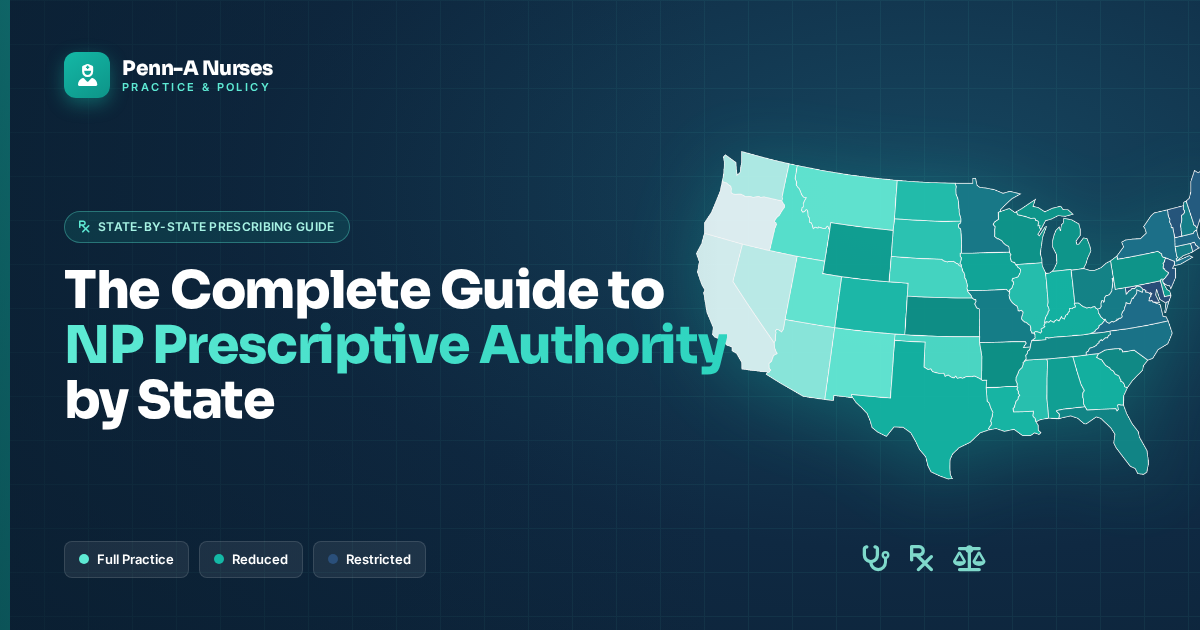
The American Association of Nurse Practitioners (AANP) classifies every state into one of three categories based on how much autonomy NPs are granted. These classifications directly determine prescriptive authority.
Full Practice Authority (FPA)
In Full Practice Authority states, NPs evaluate patients, diagnose conditions, order and interpret diagnostic tests, and prescribe medications — including controlled substances — without any mandated physician oversight. The NP practices under the exclusive jurisdiction of the state board of nursing, not the board of medicine. There is no collaborative agreement requirement, no physician co-signature on prescriptions, and no supervisory relationship to maintain.
As of 2026, approximately 27 states plus the District of Columbia grant FPA. These include Alaska, Arizona, Colorado, Connecticut, Delaware, Hawaii, Idaho, Iowa, Kansas, Maine, Maryland, Massachusetts, Minnesota, Montana, Nebraska, Nevada, New Hampshire, New Mexico, North Dakota, Oregon, Rhode Island, South Dakota, Utah, Vermont, Washington, Wyoming, and D.C. Guam and the Northern Mariana Islands also fall into this category.
FPA doesn’t always mean day-one independence. Several of these states require a transition-to-practice (TTP) period — a defined number of supervised clinical hours (typically ranging from 2,000 to 6,000) that new NPs must complete before practicing fully autonomously. Connecticut, for instance, requires 2,000 hours of collaborative practice over three years before granting full independence.
Reduced Practice Authority
In Reduced Practice states, NPs are required to maintain a career-long collaborative agreement with a physician for at least one element of their practice — most commonly prescribing. The NP can still evaluate, diagnose, and treat patients, but the collaborative agreement creates a formal legal link to a physician that must be documented, filed, and maintained throughout the NP’s career.
The specific terms of these agreements vary by state. Some require periodic chart reviews, others mandate that the collaborating physician be available by phone within a certain response time, and many define the categories of medications the NP is authorized to prescribe. States in this category include Pennsylvania, Illinois, Indiana, and several others.
Restricted Practice Authority
Restricted Practice states impose the highest level of physician involvement. NPs in these states operate under direct physician supervision, delegation, or team management arrangements. Prescriptive authority is often tied to the supervising physician’s own license, and the NP may need physician co-signatures on treatment plans and prescriptions.
States with restricted practice include Alabama, Florida, Georgia, Michigan, Missouri, North Carolina, South Carolina, Tennessee, Texas, and Virginia. In some of these states, NPs face additional limitations such as caps on the types of controlled substances they can prescribe or restrictions on the duration of certain prescriptions.
Controlled Substance Prescribing: Where It Gets Complicated
Prescriptive authority for everyday medications — antibiotics, blood pressure drugs, diabetes management — is one thing. Controlled substances introduce an entirely separate layer of regulation that combines state law with federal DEA requirements.
Federal Baseline
Every NP who prescribes controlled substances must hold a valid DEA registration. This is a federal requirement that applies regardless of state practice authority. The DEA registration must be obtained for each state where the NP has patients (relevant for telehealth practitioners operating across state lines). Additionally, the Ryan Haight Act generally requires an in-person evaluation before prescribing controlled substances, though telemedicine-specific registration frameworks have been proposed by the DEA to address remote prescribing.
State-Level Variation
Even among FPA states, controlled substance rules are not uniform. Here’s where the nuances matter most:
States with full controlled substance independence: In most FPA states, NPs with a valid DEA registration may prescribe Schedule II through V medications independently. There are no physician co-signatures required, no supply limitations beyond standard DEA regulations, and no collaborative agreement mandates.
States with specific Schedule II restrictions: Some states impose targeted limitations on Schedule II substances (the most tightly regulated category, which includes opioids like oxycodone, stimulants like amphetamine, and certain sedatives):
- Florida limits NP-issued Schedule II prescriptions to a 7-day supply, with exceptions for psychiatric nurse practitioners.
- Georgia prohibits NPs from prescribing Schedule II controlled substances entirely, regardless of practice setting.
- Illinois requires NPs to accumulate 4,000 hours of clinical experience and complete additional controlled substance-specific continuing education before prescribing Schedule II drugs.
- Pennsylvania permits CRNPs with approved prescriptive authority to prescribe Schedule II–V substances within the parameters of their collaborative agreement, but limits Schedule II prescriptions to a 30-day supply and Schedule III–IV prescriptions to a 90-day supply.
States requiring additional credentials for controlled substances: Several states require NPs to obtain a separate state-level controlled substance registration or certificate in addition to their DEA number. The application process, continuing education requirements, and renewal timelines for these state registrations vary.
Prescription Drug Monitoring Programs (PDMPs)
Nearly every state now requires prescribers — including NPs — to check the state PDMP before prescribing controlled substances. Some states mandate a check before every controlled substance prescription, while others require it only for initial prescriptions or prescriptions exceeding a certain duration. NPs practicing across state lines via telehealth need to be aware of PDMP requirements in each patient’s state of residence.
Collaborative Agreements: What They Require and What They Cost
For NPs in Reduced and Restricted Practice states, the collaborative agreement is the legal document that makes prescriptive authority possible. Understanding what it demands — and what it costs in both time and money — is critical.
What a Typical Collaborative Agreement Covers
While the specifics vary by state, most collaborative agreements (sometimes called Prescriptive Authority Collaborative Agreements or PACAs) must address:
- Scope of authorized prescribing: Which medication categories and controlled substance schedules the NP is permitted to prescribe.
- Chart review requirements: How frequently the physician must review patient records — weekly, monthly, or based on a percentage of charts.
- Availability: How and when the collaborating physician must be reachable — some states require immediate telephone availability during all NP practice hours.
- Substitution: Identification of at least one substitute collaborating physician who can fulfill the role if the primary collaborator is unavailable.
- Filing requirements: Many states require the agreement to be filed with the state board of nursing, the board of medicine, or both before the NP begins prescribing.
- Renewal schedule: Collaborative agreements typically must be reviewed and renewed every one to two years.
The Cost Factor
Collaborative agreements carry both direct and indirect costs. The collaborating physician may charge a monthly fee (ranging from a few hundred to several thousand dollars depending on the state and specialty), and the administrative overhead of maintaining, updating, and filing the agreement consumes time that independent NPs in FPA states don’t have to spend. For NPs seeking to open independent clinics, the requirement to retain a collaborating physician adds a fixed cost that can make the difference between a viable business model and an unsustainable one.
Pennsylvania: A Closer Look
Since this guide is published by Penn-A Nurses, here’s a focused look at how prescriptive authority works in the Commonwealth.
Pennsylvania classifies as a Reduced Practice state. Certified Registered Nurse Practitioners (CRNPs) in Pennsylvania can prescribe medications, including Schedule II–V controlled substances, but only under the framework of a Prescriptive Authority Collaborative Agreement (PACA) with a Pennsylvania-licensed physician.
To obtain prescriptive authority in Pennsylvania, a CRNP must:
- Complete at least 45 hours of advanced pharmacology coursework within five years of applying.
- Enter into a written PACA with a collaborating physician. The agreement must identify all parties (including at least one substitute physician), specify the CRNP’s specialty and authorized drug categories, and detail the physician’s patient-contact terms and the CRNP’s professional liability insurance coverage.
- Submit a separate prescriptive authority application to the State Board of Nursing with a $95 fee.
- File a copy of the PACA with the Bureau of Professional and Occupational Affairs (BPOA) and maintain a copy at the CRNP’s primary practice location.
Ongoing requirements include:
- Biennial renewal of prescriptive authority, concurrent with CRNP certification and RN license renewal ($41 fee).
- 30 hours of continuing education every two years, with at least 16 of those hours in pharmacology for CRNPs holding prescriptive authority.
- Collaborative agreement review and update at least every two years.
- The collaborating physician must provide genuine oversight, including immediate availability via telecommunications, regular chart reviews, and ongoing clinical consultation.
Controlled substance limits in Pennsylvania:
- Schedule II prescriptions are limited to a 30-day supply.
- Schedule III and IV prescriptions are limited to a 90-day supply.
Legislative efforts to grant FPA to Pennsylvania NPs have been introduced over multiple sessions but have not yet passed as of 2026. NPs in the state should monitor developments through the Pennsylvania Coalition of Nurse Practitioners (PACNP) for updates.
Recent Legislative Changes: What Moved in 2025–2026
The map of NP practice authority is not static. Several states have made significant changes in the past two years, and others are actively debating legislation. Here are the most notable shifts:
New Jersey enacted legislation granting FPA to primary care and behavioral health NPs with over 5,000 hours of clinical experience, effective March 2026. However, following the expiration of pandemic-era Executive Order 415 in February 2026, NPs who don’t meet the new FPA criteria returned to joint protocol requirements for prescribing.
Oklahoma passed independent prescriptive authority for qualified NPs following a 2025 veto override, effective November 2025. The law requires NPs to complete 6,240 hours of supervised clinical practice before gaining full independence.
New York has been operating under a temporary independent practice framework that was subject to a July 1, 2026, sunset clause. Legislative efforts (S2360/A1220) have been introduced to make this independence permanent. NPs in New York should verify their current legal status directly with the State Education Department.
California continues its tiered rollout under Assembly Bill 890 (AB 890). NPs who complete a rigorous 4,600-hour transition-to-practice program under physician supervision can achieve “104 NP” certification and practice independently. The first wave of NPs reached this milestone in 2026.
Indiana has seen recent legislative movement toward FPA, with ongoing adjustments to state statutes to facilitate independent practice.
These changes underscore a broader national trend: the movement toward NP independence continues to gain momentum, driven by physician shortages, demand for primary care access in underserved communities, and growing evidence supporting the quality and safety of independent NP practice.
The Impact on Your Career and Practice
Understanding prescriptive authority isn’t an academic exercise — it has direct implications for compensation, career mobility, and practice ownership.
Earning Potential
Data consistently shows that NPs in Full Practice Authority states earn approximately 8 to 12 percent more than those in restricted states. The premium is driven by the ability to bill Medicare and private insurers directly, eliminate collaborative agreement fees, and operate without the administrative overhead of physician supervision.
Practice Ownership
FPA is the primary legal gateway for NPs who want to open and operate their own independent clinics. In restricted states, practice ownership is often hindered by the legal requirement to retain a collaborating physician — a fixed cost and administrative dependency that limits the NP’s operational autonomy.
Liability Considerations
Greater autonomy comes with greater liability exposure. NPs in FPA states are more likely to be named as the sole defendant in malpractice claims, rather than sharing liability with a supervising physician. NPs practicing independently should carry individual malpractice policies that include licensing board defense coverage, and should ensure their coverage limits reflect the full scope of their autonomous practice.
Credentialing and Billing
In FPA states, NPs can generally credential and bill insurance companies directly under their own NPI number. In reduced and restricted states, billing may need to flow through the collaborating or supervising physician, which can complicate reimbursement, limit the NP’s ability to build an independent patient panel, and reduce practice revenue.
How to Verify and Maintain Your Prescriptive Authority
Regardless of which state you practice in, prescriptive authority is not a set-it-and-forget-it credential. Here’s a practical checklist for staying current:
Check your state board of nursing regularly. This is the authoritative source for your scope of practice, prescriptive authority requirements, and any recent regulatory changes. National summary maps from AANP and other organizations are useful starting points, but they may not reflect the most recent legislative updates or state-specific nuances.
Maintain your DEA registration. Federal DEA registration must be renewed every three years and must be held in every state where you prescribe controlled substances to patients. If you practice via telehealth across state lines, this means potentially holding multiple DEA registrations.
Keep your collaborative agreement current (if applicable). In states that require them, an expired or improperly filed collaborative agreement renders your prescriptive authority invalid — even if your NP license and certification are active. Calendar the review and renewal dates, and ensure your collaborating physician’s own license remains in good standing.
Complete required continuing education on time. Many states require pharmacology-specific CE hours for NPs with prescriptive authority. Track these separately from your general CE requirements and maintain documentation for at least one full renewal cycle beyond the most recent.
Monitor PDMP requirements. State PDMP rules change frequently. Know whether your state requires a check before every controlled substance prescription, only initial prescriptions, or prescriptions above a certain duration or quantity threshold.
Stay informed about legislative changes. Join your state NP association and follow organizations like the AANP, your state coalition of nurse practitioners, and relevant legislative tracking services. Laws governing NP prescriptive authority are among the most actively debated healthcare statutes in the country, and changes can take effect with relatively short notice.
Final Thought
NP prescriptive authority is not a single national standard — it’s a patchwork of 50 different regulatory frameworks, each with its own rules for what you can prescribe, how you can prescribe it, and who needs to sign off. The trend line points clearly toward greater independence, but the pace varies dramatically from state to state. Whether you’re navigating a collaborative agreement in Pennsylvania or practicing with full autonomy in Colorado, the NPs who thrive are the ones who know their state’s rules inside and out — and stay ahead of the changes coming next.